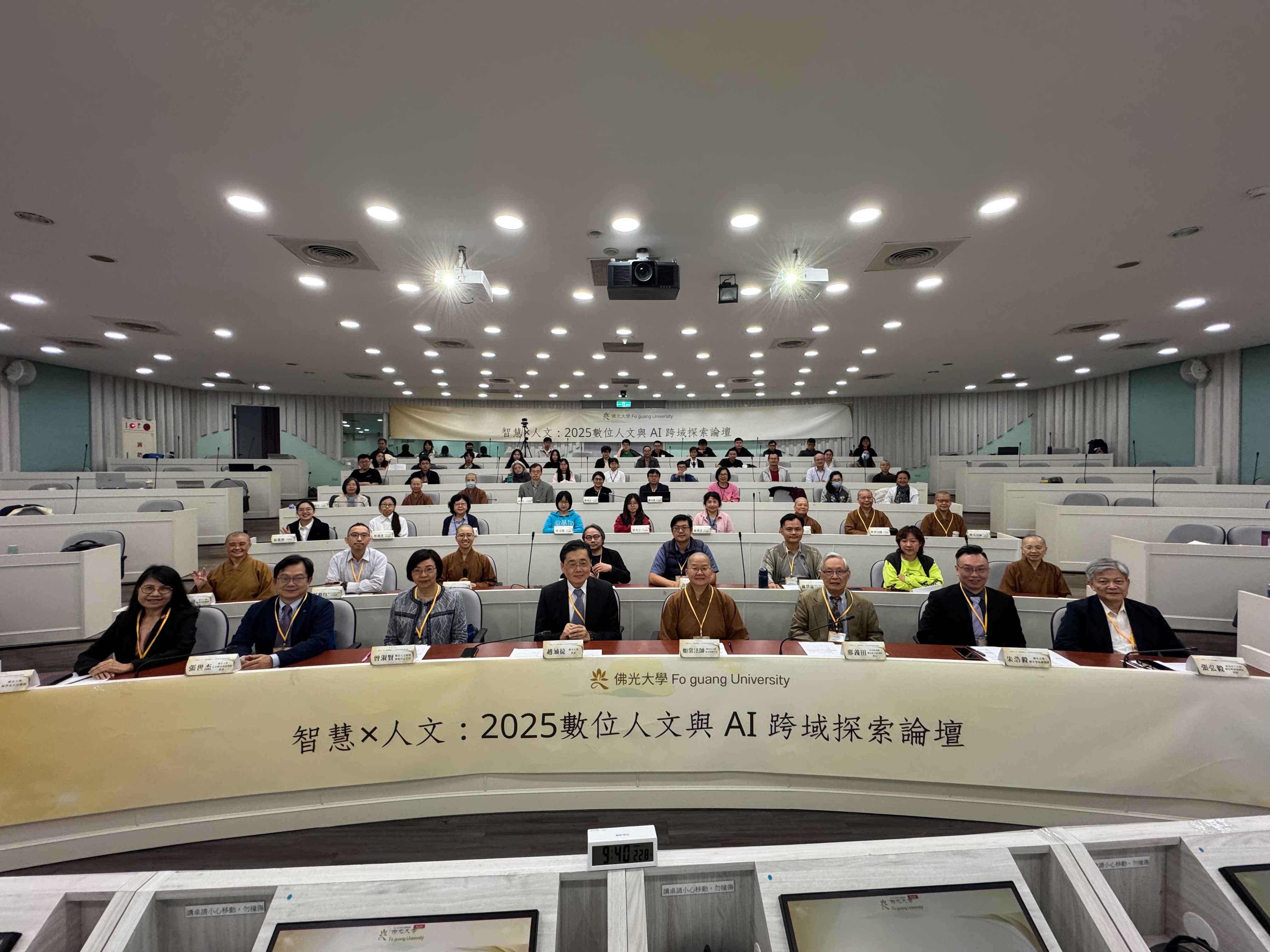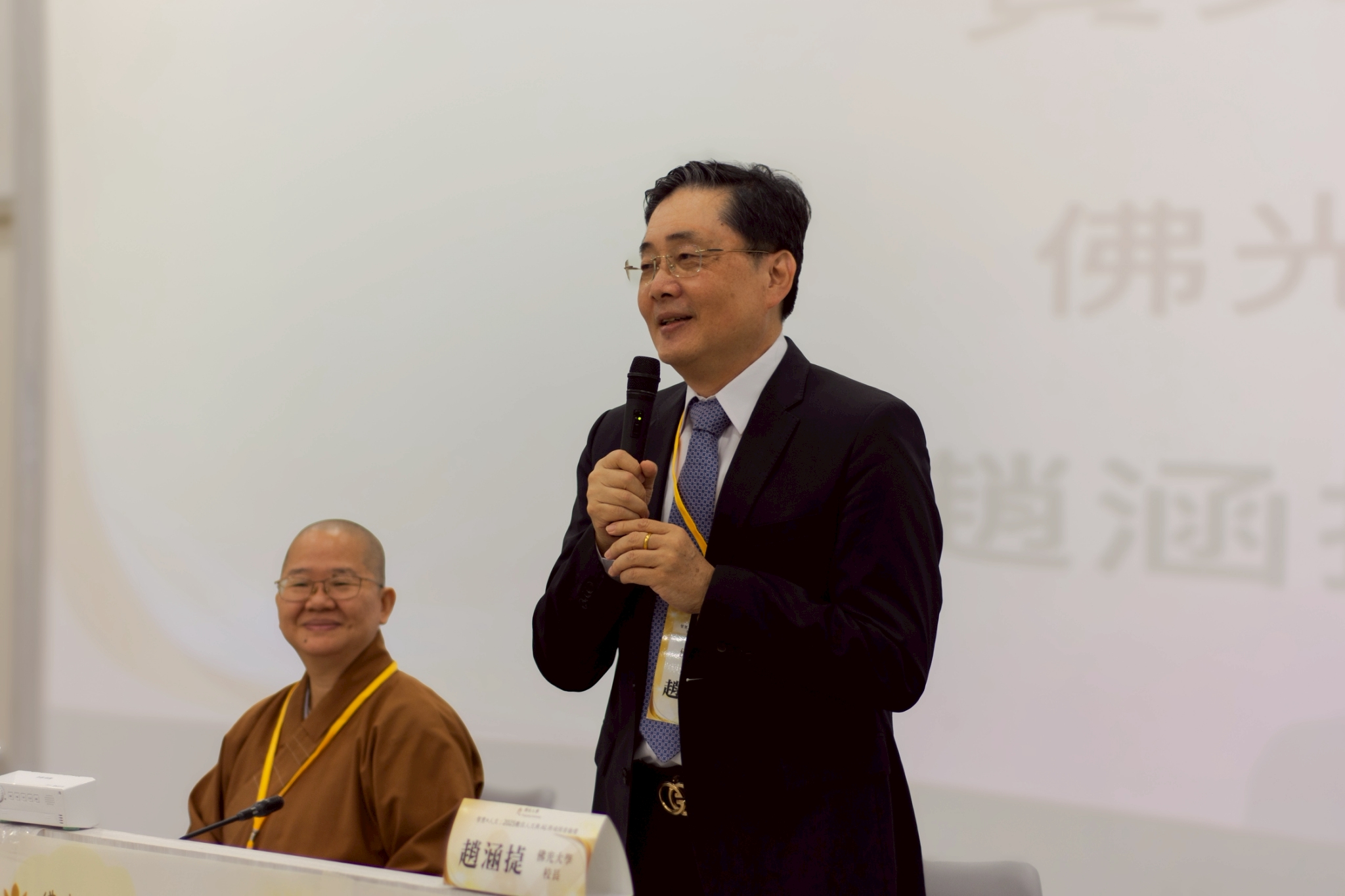

The first day opened with a performance by the FGU Buddhist College Zheng Ensemble, led by Venerable Chueh Guan. The combination of guzheng music and vocal recitation expressed the students’ remembrance of Venerable Master Hsing Yun’s enduring support for the university. The opening ceremony, presided over by Director Tseng Shu-Hsien, featured remarks from President Chao Han-Chieh and Venerable Ru Chang, Executive Director of the Fo Guang Shan Foundation for Buddhist Culture and Education. President Chao warmly welcomed all guests and highlighted that beginning next year, every academic unit at the university will integrate AI throughout its curriculum, making the timing of this forum both timely and auspicious. Venerable Ru Chang reflected on the theme of “wisdom,” noting that its opposite is “affliction,” and expressed the hope that the discussions would help participants overcome afflictions and collectively pursue wisdom. Director Tseng also announced ongoing progress in the Center’s digital humanities initiatives, including the upcoming launch of the digital platform for Venerable Master Hsing Yun’s artifacts next year.
This year’s forum featured three keynote lectures and seven presentations on teaching and research. The opening keynote was delivered by Academia Sinica Academician Hsing I-tien, who reflected on the trajectory of human history and raised the question of whether the Industrial Revolution represented advancement or accelerated destruction. He pointed out that current AI technologies are still unable to address issues such as human self-awareness, creativity, emotional and sentiment measurement, and uniquely human moral and value judgment that cannot be modeled, meaning AI cannot replace the human brain through learning and computational power alone. Should AI one day overcome these barriers, it could potentially herald humanity’s downfall, as machines might then fully replace human beings.
The second keynote was delivered by Venerable Miao Shu on behalf of Venerable Yung Ben, detailing the multi-decade digitization of the Fo Guang Shan Buddhist Canon. After nearly half a century of dedicated effort, Fo Guang Shan has completed 9 of the 16 collections of the canon and subsequently released digital editions, mobile apps, and now AI-assisted scripture interpretation. These initiatives aim to advance the digital transmission of the Dharma and fulfill Venerable Master Hsing Yun’s aspiration that “everyone to read, reading with easy understanding, understanding leading to faith, and faith leading to easy practice,” thus promoting modern Humanistic Buddhism.
Following these addresses were three expert presentations. Professor Lin Sinn-Cheng of Tamkang University shared his experience integrating digital curation with local revitalization, including the creation of a metaverse-style virtual space for the Greater Tamsui–Keelung region. Distinguished Professor Chen Chih-Ming, Director of the Graduate Institute of Library, Information and Archival Studies at National Chengchi University, introduced the principles of Multimodal Retrieval-Augmented Generation (MRAG) and discussed the application of Large Multimodal Models (LMMs) in digital humanities, such as automated text annotation and the analysis of religious images like Ten Kings paintings. Associate Researcher Chen Shu-Jiun of Academia Sinica’s Institute of History and Philology reviewed the development and use of four types of linked data in international digital humanities research over the past decade.
Continuing the prior day’s dialogue between the humanities and technology, the second day began with a keynote address by Dean Li Cho-Ying of National Tsing Hua University’s College of Humanities and Social Sciences. Dean Li shared classroom experiences using generative AI to support historical research and creative writing. Addressing the ongoing rise of AI, Dean Li emphasized that key academic competencies, asking precise questions, discerning the quality of AI-generated suggestions, and employing effective AI collaboration strategies, remain crucial for maximizing the benefits of generative AI. These abilities, cultivated through disciplinary training, are not merely supplemental to AI, but essential for enabling AI to function effectively.
The next presentation was offered by Venerable Miao Guang, Deputy Chancellor of the Fo Guang Shan Institute of Humanistic Buddhism, who introduced the digital implementation of the Fo Guang Dictionary of Buddhism Translation Project. Empowered by AI, the project has produced the world’s only Chinese–English bilingual Buddhist dictionary and built a multilingual corpus of Humanistic Buddhism, becoming an impressive and comprehensive knowledge graph.
This was followed by three presentations from Fo Guang University faculty. Director Chu Hao-Yi used the “Ten Records” of the Book of Han to explain generative AI “hallucinations” (false and inaccurate information). Assistant Professor Jhuang Hao-Bin discussed the challenges students encounter when using digital humanities tools in Taiwan history courses. Assistant Professor Dai Rong-Guan demonstrated the classroom application of digital humanities tools, including SNA social network graphs, Corpro text analysis, and DocuGIS2 visualization maps, etc., to deepen students’ understanding of Venerable Master Hsing Yun’s Humanistic Buddhism thought.
The two-day program concluded with a comprehensive panel moderated by Director Chu. Director Tseng expressed special appreciation for the students of the Department of Buddhist Studies for their dedicated assistance throughout the event. After the forum, Professor Jhuang Hao-Bin of the Department of History led participating scholars on a cultural excursion to learn about the local glass eel industry, adding a warm and human touch to an academic event centered on AI.