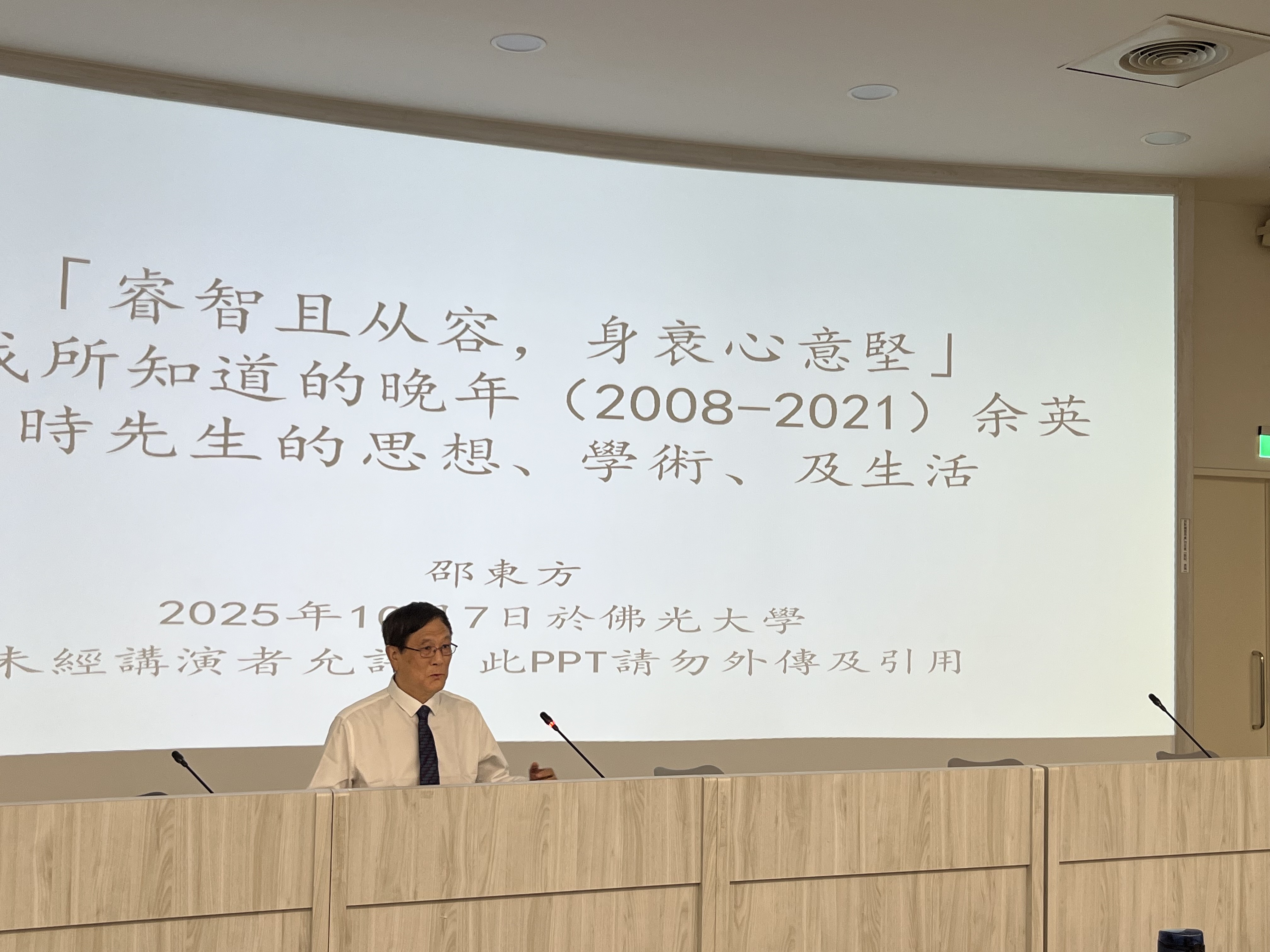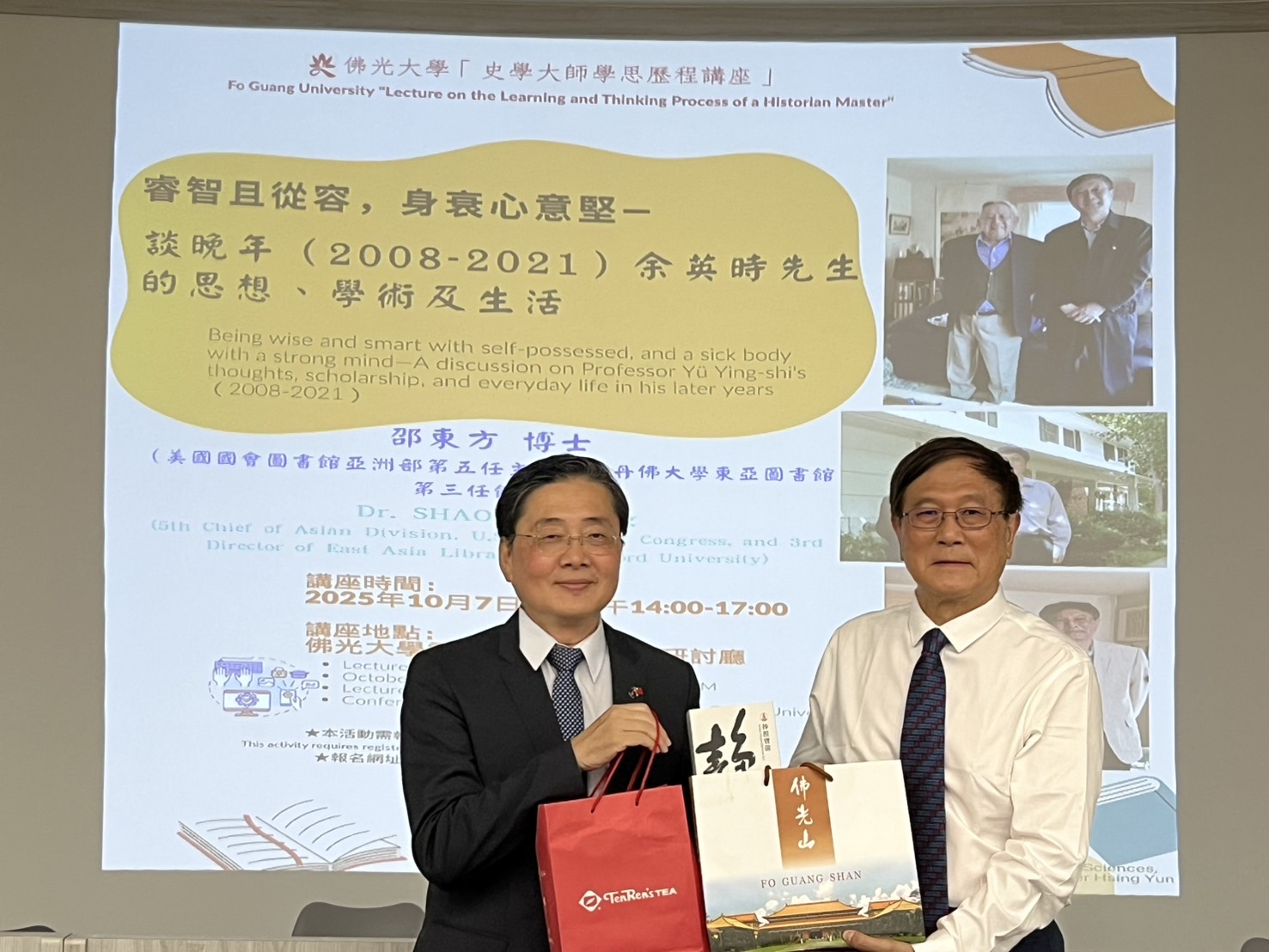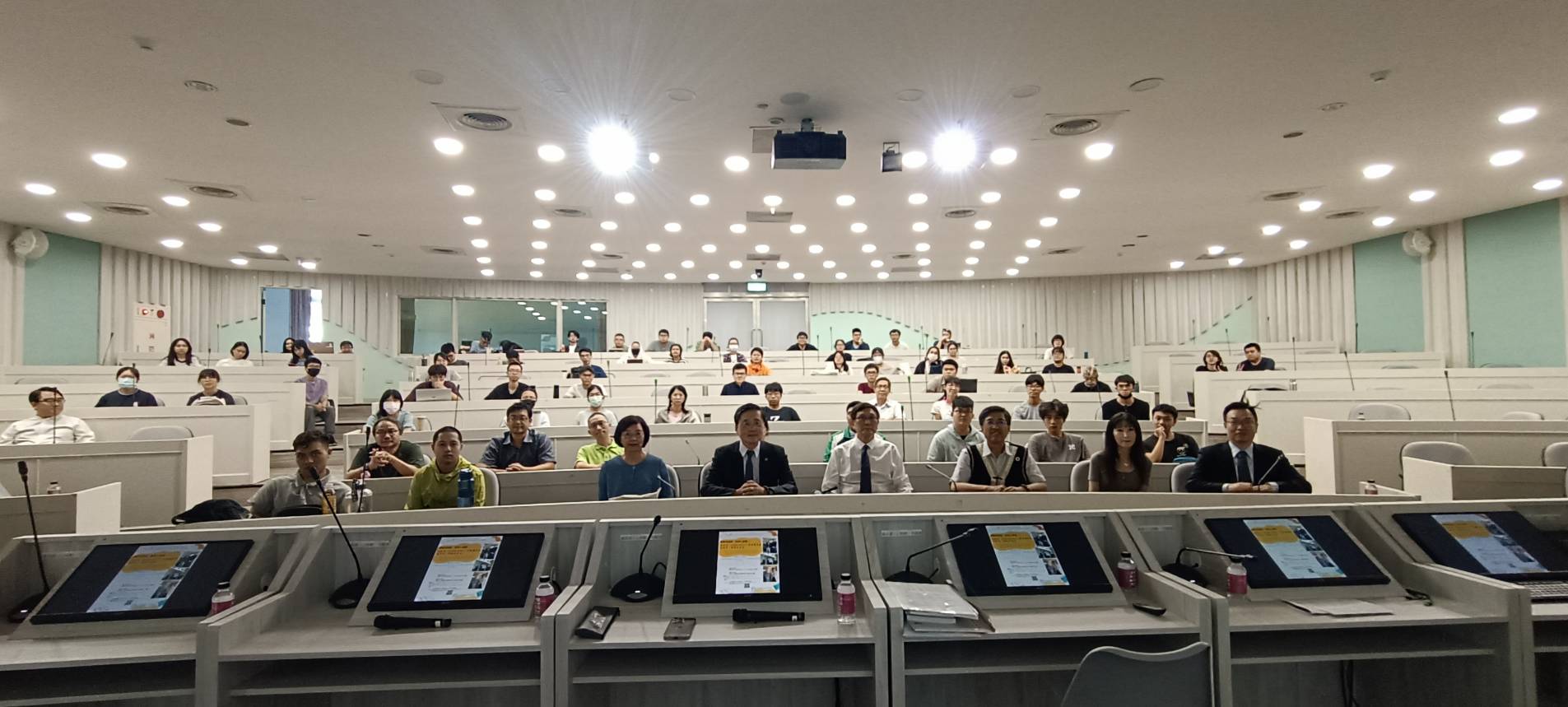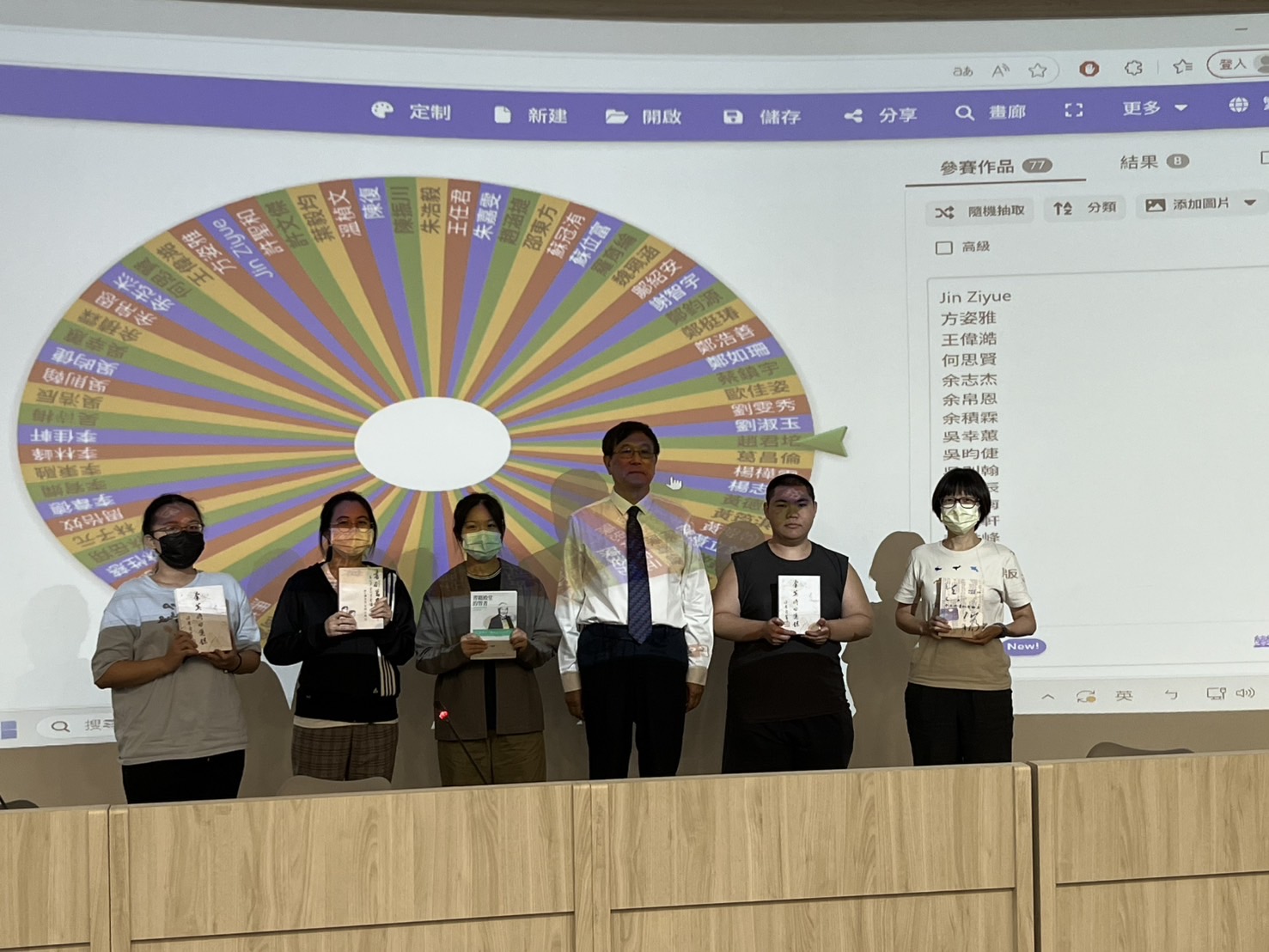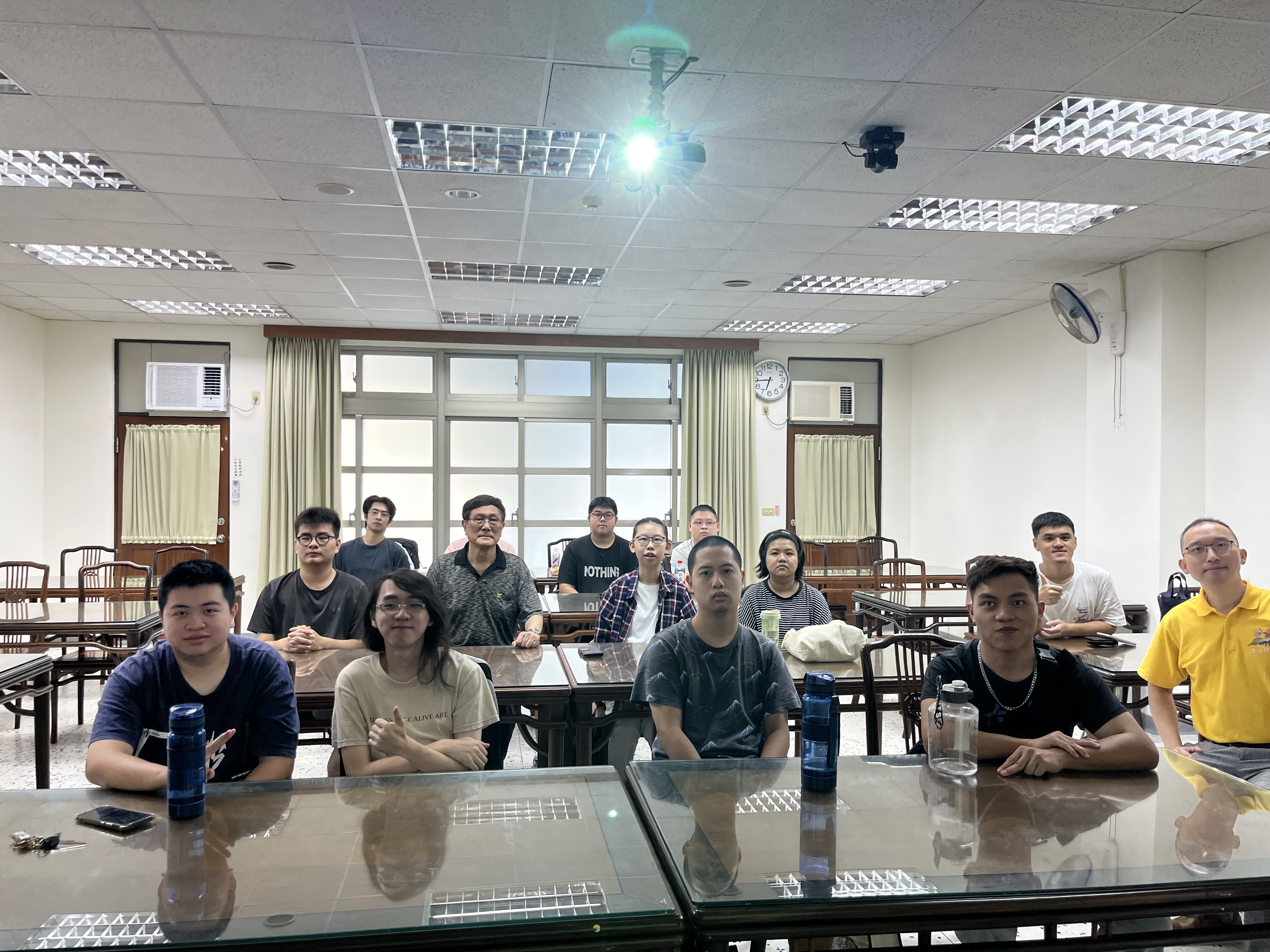

On October 7, the Venerable Master Hsing Yun Digital Humanities Research and Development Center and Department of History jointly hosted an academic lecture, welcoming Professor Shao Dongfang, who recently retired from the Library of Congress, to visit the university. Through the gracious invitation of President Chao Han-Chieh and with assistance from Professor Chu Chia-Wen, Dean of the College Huailan at National Dong Hwa University, Professor Shao was able to visit Fo Guang University. Nearly one hundred faculty members and students attended the event.
The lecture began with opening remarks from President Chao Han-Chieh. In addition to extending a warm welcome, President Chao modestly noted that he was not a specialist in humanities research and invited Chern Jenn-chuan, CEO of the Tang Prize Foundation and Professor Emeritus of Civil Engineering at National Taiwan University, to elaborate on the academic stature of Academician Yu Ying-shih (the subject of the lecture). Chern introduced Professor Yu as the first recipient of the Tang Prize in Sinology, highlighting how his lifetime of exceptional scholarly achievements earned both the Library of Congress’s Kluge Prize, known as the “Nobel Prize of the Humanities,” and Taiwan’s Tang Prize in Sinology. A video of former President Ma Ying-jeou presenting the award was shown at the event.
Professor Shao began his lecture by sharing his personal connection with Venerable Master Hsing Yun, recalling vivid memories of hosting the Venerable Master multiple times at Stanford University and Venerable Master’s attitude of curiosity about everything. He then proceeded to reveal many important aspects of Professor Yu Ying-shih not widely known to most people, such as how his maternal line descended from the Tongcheng Zhang clan, with his maternal grandfather being the seventh-generation descendant of Zhang Tingyu, an important minister during the Qing Kangxi Emperor’s reign. Professor Shao also clarified that Yu’s actual birthday was February 19, 1930. The commonly cited January 22 arose from mistaking the lunar date for the solar one and not understanding that the Yu family commemorated the day of his mother’s difficult labor.
This lecture focused on the years after 2008 because in October of that year, Professor Shao visited and interviewed Professor Yu, later publishing On Historical Research Experience, an important record of Yu’s intellectual reflections. In 2012, when Professor Shao transitioned from Director of the East Asia Library at Stanford University to Chief Director of the Asian Division at the Library of Congress, a position he obtained with Professor Yu’s strong recommendation, geographical proximity allowed him to interact frequently with Professor Yu and his wife, Chen Shu-ping. These encounters offered Professor Shao firsthand insight into Yu’s later life.
Professor Chu Chia-Wen, now Dean at National Dong Hwa University and formerly a faculty member at Fo Guang University, recalled that when Professor Shao served as a visiting professor in the Department of History. He devoted great effort to mentoring junior scholars, introducing valuable materials on many female writers who moved to Taiwan and later immigrated to the United States, for which Professor Chu remains deeply grateful.
In addition to emphasizing Professor Yu’s late-career English-language publications, Professor Shao particularly discussed Yu’s profound observations on contemporary mainland China and his continued attention to developments in modern Western academia.
The lecture was rich with insights, touching upon other master historians such as Ch’ien Mu, Yang Lien-sheng, Ho Ping-ti, Hsu Cho-yun, and Chang Hao; eminent Western sinologists including William Theodore de Bary, David Nivison, and Albert Dien; as well as influential contemporary intellectuals.
Professor Shao concluded by adapting a couplet from Duan Yucai:
“A thousand autumns of achievement in history and sinology;
A great scholar of the age, teacher in learning and in virtue.”
This couplet honored Professor Yu’s scholarly integrity and personal character. Combined with the speaker’s many detailed and intimate observations, the talk vividly brought Professor Yu to life as a warm and real human presence.
On the morning of October 8, Professor Shao also visited Professor Yeh Yi-chun’s “Historical Research and Writing” course in the Department of History, offering guidance to undergraduates on historical research methods and thesis writing. Students found his advice deeply inspiring, bringing this lecture series to a meaningful and memorable close.
Login Venerable Master Hsing Yun Digital Humanities R&D Center