
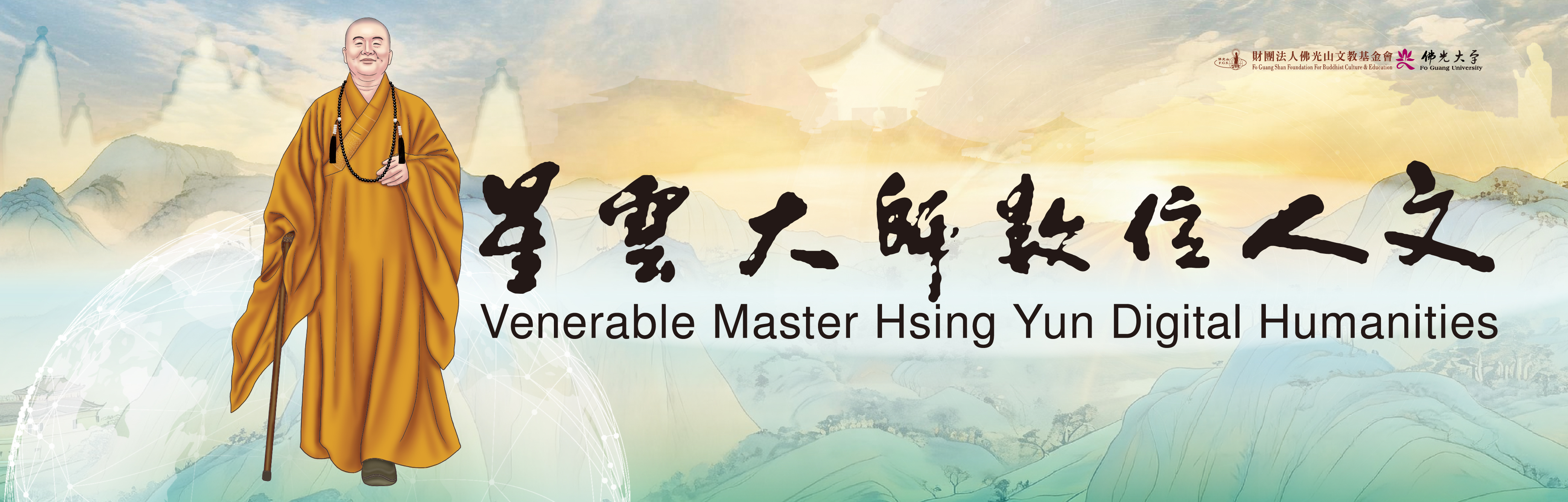
Amidst the current wave of AI, in order to build a concrete and meticulous database of Venerable Master Hsing Yun, a project was led by former National Central Library Director Tseng Shu-hsien at the Fo Guang University Venerable Master Hsing Yun Digital Humanities Research Center. Venerable Miao Guang, Director of the Fouder’s Hall Secretary Office; Venerable Ru Chang, Director of the Buddha Museum and Executive Director of the FGS Foundation for Buddhist Culture and Education; Venerable Miao Fan, Chancellor of the Fo Guang Research Institute of Humanistic Buddhism; and FGS Tsung Lin University have collectively dedicated nearly two years to this effort. With the support of donors James and Lydia Chao, a database containing 530,000 entries has been initially established.
On the internet, tools like ChatGPT, Gemini, and NotebookLM are being used with great fervor, as if one could obtain ideas and suggestions without any effort at all. However, having actually participated in the construction process, I have come to understand that the difficulties at the foundational level required to obtain accurate data are unknown to most. Especially given the sixty-year development of Fo Guang Shan and the complex process of the Venerable Master’s nearly century-long Dharma propagation, there is a vast amount of data that must be established from scratch. This reminds me of the fool in the Sutra of One Hundred Parables who envied a castle in the air; without a foundation, there is no scenery. How we should construct this to create a landscape of Humanistic Buddhism digital humanities is truly extraordinary, yet vast and arduous.
Throughout this process, I have been deeply moved by several key individuals. First are James and Lydia Chao, who embody the spirit of "one teacher and one path." Their care and guidance are always equal and selfless; with a simple, "Just tell us whatever you need!" they have provided unwavering support from beginning to end without a second thought. Second is Director Tseng Shu-hsien. After retiring from the high-ranking position of Director of the National Central Library, she returned to the grassroots level to participate without complaint. She took charge of communicating with the Venerables of Fo Guang Shan and negotiating with vendors, all while respecting academic protocols and elegantly bridging the connections between all parties.
Third is Venerable Ru Chang, who holds multiple responsibilities. She took to heart the instruction of our founder, Venerable Master Hsing Yun: "In the future, the materials of Fo Guang Shan must be provided to the whole world for use without conditions!" This led her to simultaneously promote the Buddha Museum’s development as a top-tier international museum while sparing no effort to connect vendors unfamiliar with Fo Guang Shan with Venerables who were new to AI. Fourth is Venerable Miao Guang, Director of the Founder’s Hall Secretariat. She travels weekly between Fo Guang Shan and Fo Guang University, hoping to promote the Venerable Master’s original manuscripts, historical records, itineraries, and artifacts, always bearing the expectations and pressures from all sides with gentleness, patience, and quiet dedication. Finally, there are Venerable Miao Fan and Venerable Miao Guang of the Fo Guang Shan Institute of Humanistic Buddhism. With their expertise in cutting-edge AI data concepts and language translation, they have laid a solid foundation for digital humanities to reach the entire world.
On the return trip, a fellow student who had served as a senior executive in data engineering in Hong Kong shared that the two years spent on this project were merely the beginning. It was exceptionally difficult, and there is still a long road ahead for future research and promotion. I was taken aback, and just as I was about to feel discouraged, Venerable Yung Jung, who was driving us back to the monastery, encouraged Venerable Miao Guang and me, saying, "Do not be afraid. As long as we make a little progress every day, Humanistic Buddhism will only get better and better!" My heart was stirred. How wonderful! It is indeed true: as long as the technical direction is correct and the philosophy does not depart from Humanistic Buddhism, we will surely make daily progress.
Back at the Buddhist college, watching the students handcraft Teacher’s Day cards for their instructors, singing songs, and presenting them to their respected teachers, I felt a touching and sincere sentiment. This single thought of the etiquette of respecting teachers and the Dharma truly evokes the ethics of the master-disciple relationship within the monastery. I wondered why these students, coming from the most modern backgrounds, are willing to resolve to undergo rigorous cultivation and use the most primitive and simple handwritten cards to express warm blessings. Surely, in their hearts, the Buddha has ignited a different kind of radiance.
Thus, although Humanistic Buddhism utilizes the most advanced AI technology for the benefit of the public, practitioners themselves never depart from the enlightenment of their own minds. As Most Venerable Hsin Bao has said, at the intersection of AI and BI (Buddha Intelligence), we must continuously develop the treasure of our own minds. I believe that the Venerable Master Hsing Yun Digital Humanities Platform, through the self-awakening of practitioners, will respond to the human world with a measure of skillful prajna, and it will inevitably become one of the most beautiful landscapes in the development of Humanistic Buddhism.
[Teacher’s Words]
The Intersection of AI and BI: Venerable Master Hsing Yun’s Digital Humanities
By Venerable Miao Nan (Chancellor of FGS Tsung Lin University)
Merit Times, September 26, 2026
Merit Times, September 26, 2026